


Which Corporate Announcements Get the Most Attention? Human and AI Views Tell a Different Story
Updated: 1 day ago
Disclosure Intelligence Series How disclosure works in modern capital markets

Not all corporate announcements attract the same level of attention.
A new TMX Newsfile analysis examined approximately 30,000 press releases distributed through TMX Newsfile between January 1 and August 31, 2026, comparing observed human and AI views across six common announcement types.
The results show that views varied by announcement type, and the categories attracting the most human attention were not exactly the same as those generating the most AI views.
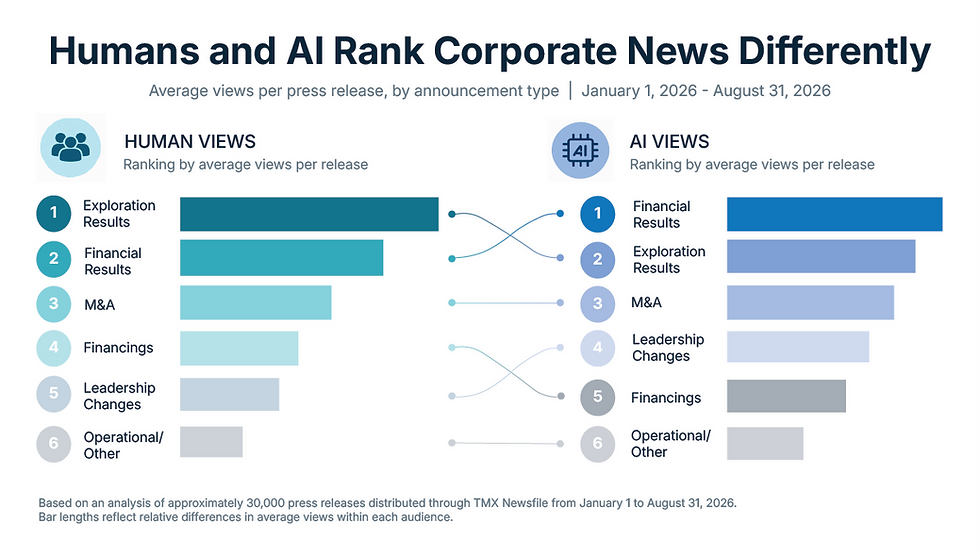
Exploration Results generated the highest average human views in the analysis, while Financial Results generated the highest average AI views.
The findings offer another view into how corporate disclosure is being consumed by two distinct audiences.
Human Views Were Highest for Exploration Results
Among the six announcement categories analyzed, Exploration Results generated the highest average human views per press release.
Average human views for Exploration Results were 44% higher than Financial Results, the next-highest category, and 68% higher than M&A announcements.
The difference became considerably larger further down the ranking. Exploration Results generated 213% more average human views than Operational / Other announcements, the lowest-ranked category.
The results suggest that human attention varied substantially depending on the type of corporate information being announced.

The spread between categories was also wider for human views than for AI views. This suggests that announcement type may have a stronger relationship with variation in human attention.
AI Views Followed a Different Ranking
AI views followed a different pattern.
Financial Results generated the highest average AI views per press release, ranking ahead of Exploration Results and M&A.
Financial Results generated 28% more average AI views than Exploration Results, the next-highest category, and 29% more than M&A.
Unlike the human results, however, the leading AI categories were relatively close together. Financial Results generated 35% more average AI views than Financings, which ranked fifth.

The difference between the two audiences is notable. The highest human category generated 213% more average views than the lowest, compared with a 116% difference for AI views. This suggests that human views varied more widely by announcement type, while AI views were comparatively more consistent.
What Could Be Driving the Differences?
The data shows an association between announcement type and observed views, but it does not establish why those differences occurred.
Announcement categories can also overlap with other characteristics.
For example, Exploration Results may include a substantial number of mining and resource issuers.
Company size, public profile, investor following and the materiality of individual announcements may also influence activity.
For that reason, the results should not be interpreted to mean that one announcement category will automatically generate more views than another.
The type of announcement can help explain differences in views, but it does not determine how a press release will perform.
Average and Median Tell Different Parts of the Story
One useful feature of the analysis was the ability to compare both average and median views.
Across every human announcement category analyzed, the average was higher than the median.
That indicates that some releases generated substantially more views than the typical release within their category, pulling the average upward.
For AI views, averages and medians were generally much closer across the leading categories, although a larger difference appeared within Operational / Other.
This distinction matters when evaluating disclosure performance. A relatively small number of highly active announcements can raise an average significantly, while the median provides a better indication of where the middle of the distribution sits.
This is consistent with earlier TMX Newsfile research showing that press release activity can be highly uneven, with exceptional announcements generating substantially more attention than others.
About the analysis: Views represent raw web traffic hits/page views recorded by the TMX Newsfile system. Results compare average and median observed views across six announcement categories. The analysis shows patterns and relationships in the data, but it does not prove that announcement type caused the differences in views.
What This Means for IR and Communications Teams
The findings do not suggest that companies should change the types of announcements they issue to generate views. Corporate disclosure should be driven by the information a company needs to communicate.
They do, however, provide useful context for understanding performance.
Different types of corporate announcements may naturally attract different levels of attention. That means a release should not always be judged against every other press release in the same way.
A more useful question may be:
How did this announcement perform relative to other releases communicating similar types of information?
Corporate press releases do not enter the market in identical circumstances. The type of information being announced can influence the level and pattern of attention that follows.
The new data suggests that understanding disclosure performance requires looking not only at how much attention a release receives, but also at what is being announced and which audience is engaging with it.


