


What Drives AI Visibility in Press Releases? 21,000+ Releases Challenge Common Claims
Updated: Jul 27
Disclosure Intelligence Series
How disclosure works in modern capital markets

Can press releases be optimized for AI discovery solely through formatting and keyword strategies, as commonly suggested?
As AI becomes an increasingly important gateway to corporate information, a growing number of recommendations suggest that formatting techniques and keyword strategies can improve AI visibility, despite limited empirical evidence. While formatting may support readability, this analysis focuses on how content patterns relate to performance.
To evaluate these claims, TMX Newsfile analyzed more than 9.3 million AI interactions across over 21,000 press releases distributed during the first half of 2026, examining how announcements actually perform rather than testing specific formatting techniques in isolation.
The findings suggest otherwise. There is little evidence that commonly recommended keyword practices and related content patterns are associated with higher AI visibility. Instead, AI activity varied significantly across industries and was concentrated among a relatively small number of announcements that substantially outperformed their sector baselines.
Understanding these findings begins with an important distinction between machine readability and AI visibility.
In this analysis, “keywords” refer to the meaningful words within a press release after removing common filler words such as “the,” “and,” and “is.” This allows the analysis to focus on the terms that carry the core information in each announcement.

“Formatting helps AI understand information, but it does not necessarily make that information more visible.”
To understand these patterns, press release performance was evaluated across multiple indicators and assessed relative to others within the same industry, making it possible to distinguish typical performance from statistical outliers.
Measuring Performance in Modern Disclosure
As AI increasingly influences how corporate information is discovered and interpreted, understanding press release performance within AI systems has become an important part of modern disclosure.
Press releases are continuously processed by AI systems, indexed across search engines, financial data platforms, and information aggregators, and referenced over time. This creates measurable differences in how announcements perform after publication.
This analysis includes 21,549 press releases, providing a comprehensive view of AI activity across sectors and issuer types.
To ensure fair comparisons across industries, each press release was evaluated relative to others within its sector, making it possible to distinguish typical performance from statistical outliers.
What Defines an Outlier in Performance
A performance outlier is a press release that significantly exceeds or falls below typical levels of activity within its industry.
Identifying outliers helps distinguish unusually high- or low-performing announcements from typical performance within each industry.
AI Visibility in Press Releases Is Not Driven by Keyword Repetition Alone
The analysis found little evidence that commonly recommended keyword repetition and content patterns
are associated with higher AI visibility.
These findings challenge the growing narrative that press releases can be optimized for AI visibility through keyword repetition alone.
To explore this further, the analysis examined whether increasing keyword repetition, a common indicator of keyword stuffing, was associated with higher levels of AI activity.
This chart shows how much a single word dominates a press release, helping identify whether excessive repetition is associated with AI activity.
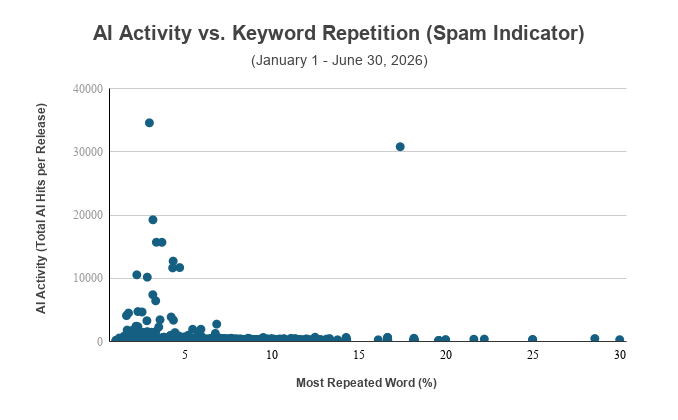
The data shows no consistent relationship between repetition of a single word and AI activity. High-performing press releases appear across a wide range of repetition levels, indicating that excessive repetition alone does not improve AI visibility. Taken together, these findings suggest that AI visibility is influenced less by repetition patterns than by the substance and relevance of the information being disclosed.
How AI Activity Changes with Content Length
This analysis examines how the length of a press release relates to AI activity, using the number of meaningful words after removing common filler words.
As content length increases, AI activity initially rises, reaches a peak, and then begins to decline. This suggests that while very short releases may lack sufficient detail, simply adding more content does not continue to improve AI visibility.
Instead, the strongest performance occurs within a natural range, where content remains clear, focused, and centered on communicating substantive information rather than unnecessary length.

What This Means for Issuer Teams
The analysis suggests that AI visibility is driven less by formatting or keyword repetition than by the significance and relevance of the information being disclosed.
This does not diminish the importance of structure. Clear headings, logical organization, and well-written disclosures remain essential for machine readability, helping AI systems accurately extract and interpret information. However, the analysis found little evidence that these practices alone are associated with higher AI visibility.
For issuer teams, the implication is straightforward: focus first on communicating meaningful information, then present it in a format that is easy for both people and AI systems to understand.
This analysis challenges the assumption that repeating keywords or adjusting content patterns alone can improve AI visibility. Instead, the findings suggest that the announcements generating the strongest AI activity are distinguished less by how they are formatted than by the significance and relevance of the information they contain.
The results also reinforce an important distinction between machine readability and AI visibility. Clear structure helps AI systems extract and interpret information, but does not necessarily make that information more visible.
If formatting and keyword repetition alone do not explain AI visibility, what does? Part 2 of the Disclosure Intelligence Series explores the characteristics that distinguish the highest-performing press releases from their peers


